From Cost to Capability: The New Drivers of Vietnam's Export Competitiveness
04/08/2026
Although the new tariff framework has already taken effect, discussions between Vietnam and the United States remain ongoing. Alongside trade promotion activities, Vietnam continues to submit supplementary documentation demonstrating that tariff-affected export sectors comply with regulations on forced labour, origin verification and supply chain governance, supporting future reviews of its current tariff classification.
Whether these efforts eventually lead to tariff adjustments remains uncertain. Ultimately, evidence of stronger enforcement, lower customs detention rates and improved supply chain traceability will likely carry greater weight than policy commitments alone.
More importantly, these efforts are valuable beyond the prospect of a lower tariff rate. As compliance and transparency become increasingly important in global trade, strengthening these capabilities will help Vietnamese exporters compete not only in the US market, but across other major export destinations.
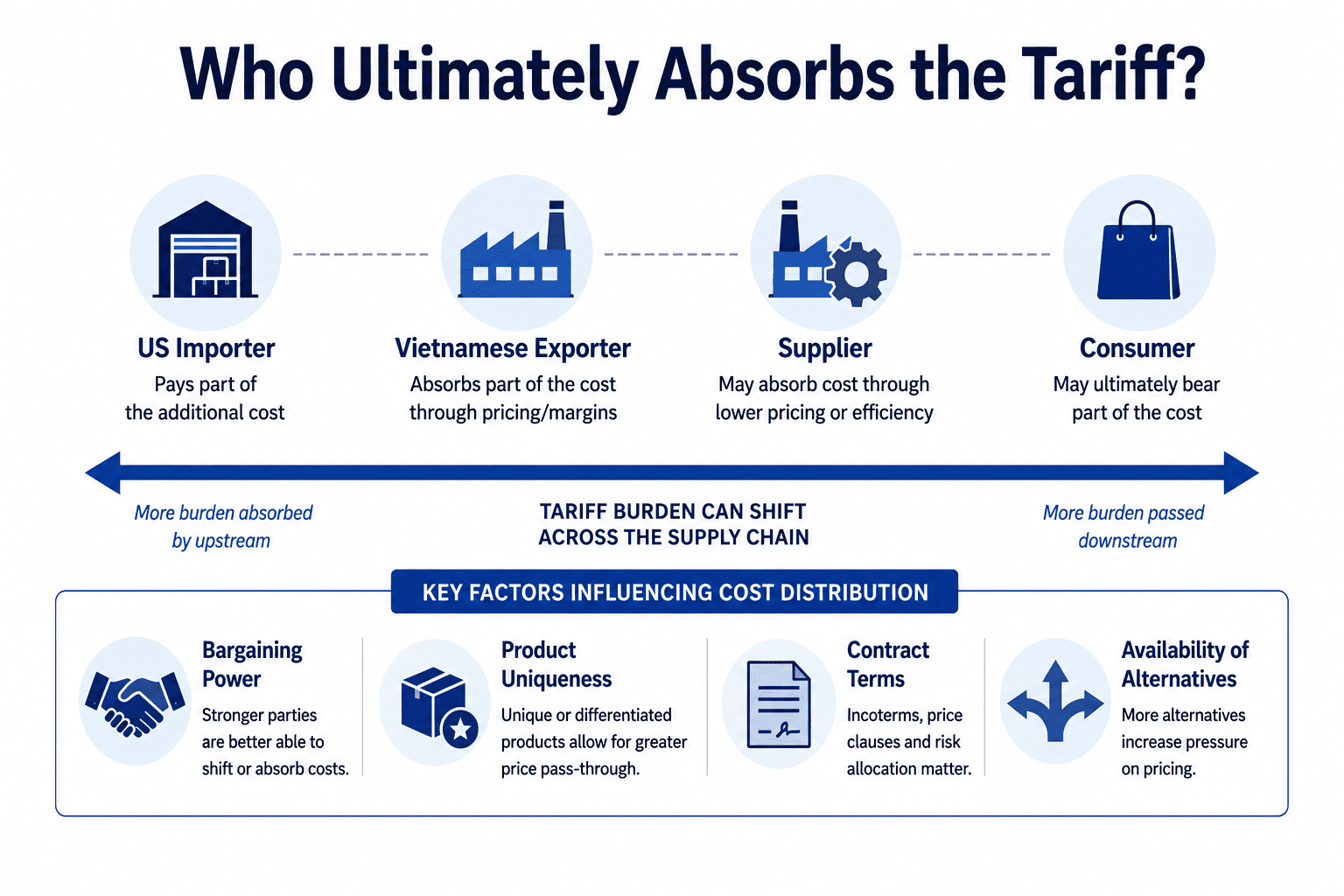
When a new tariff is imposed, who actually pays the bill?
In reality, the additional cost is rarely borne by a single party. Instead, it is often negotiated and shared across the supply chain, with the final distribution depending on bargaining power, product characteristics, commercial terms and market conditions.
Rather than simply absorbing higher costs, businesses are responding in different ways—from renegotiating contracts and adjusting pricing strategies to optimising logistics, strengthening supply chain resilience and improving compliance capabilities.
 According to Allianz Research, profit margins for tariff-affected products declined by as much as 5.5% compared with a no-tariff scenario, reaching their lowest level in the third quarter of 2025. Margins gradually recovered thereafter as businesses adjusted pricing strategies and redistributed costs across the supply chain. However, the recovery has been uneven. Manufacturing has shown a stronger rebound, while the retail, wholesale, transportation and warehousing sectors continue to face significant pressure.
For Vietnamese businesses, the ability to share the additional cost largely depends on their position within the supply chain. Companies offering differentiated products, maintaining stable customer relationships and facing limited direct competition generally have greater room to negotiate. By contrast, businesses competing primarily on price are more likely to come under pressure to reduce selling prices in order to offset the additional tariff burden.
How can businesses respond?
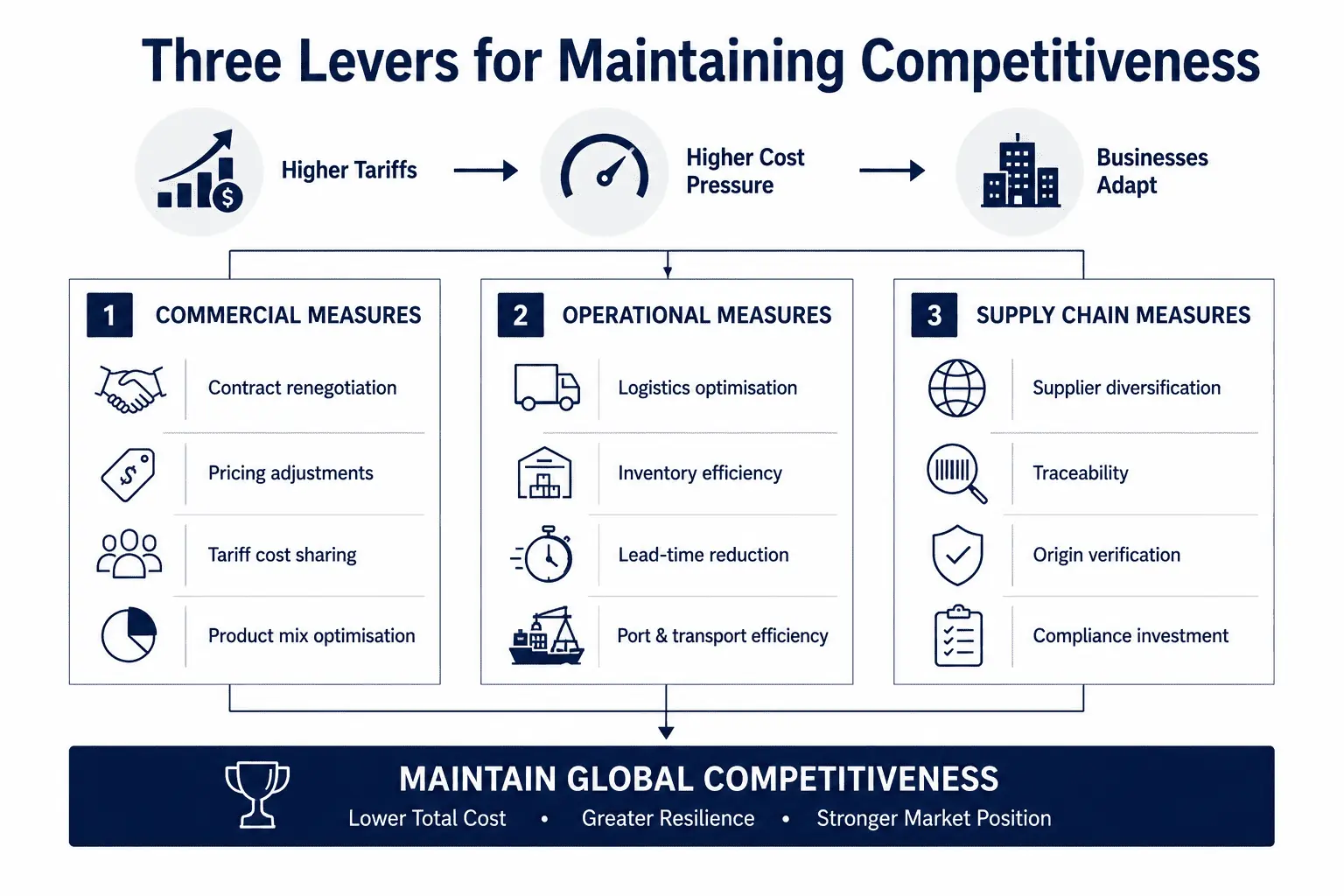
Responding to higher tariffs involves far more than renegotiating prices. Companies need to look beyond the tariff itself and examine the total landed cost of serving the US market—from raw material sourcing and production to inventory management, transportation and delivery lead times.
As tariff-related costs rise, logistics becomes one of the most effective levers businesses can actively optimize. Shorter lead times, lower warehousing costs, fewer port-related expenses and more efficient transport planning can help offset part of the additional tariff burden without relying solely on price reductions.
Not All Industries Are Equally Positioned to Adapt
While the new tariff framework applies across a broad range of exports, its commercial impact is unlikely to be uniform. Industries differ significantly in their ability to adapt, depending on pricing power, value-added production, supply chain integration and reliance on imported intermediate inputs. For some sectors, higher tariffs primarily compress margins. For others, they reinforce the need to accelerate longer-term investments that were already underway.
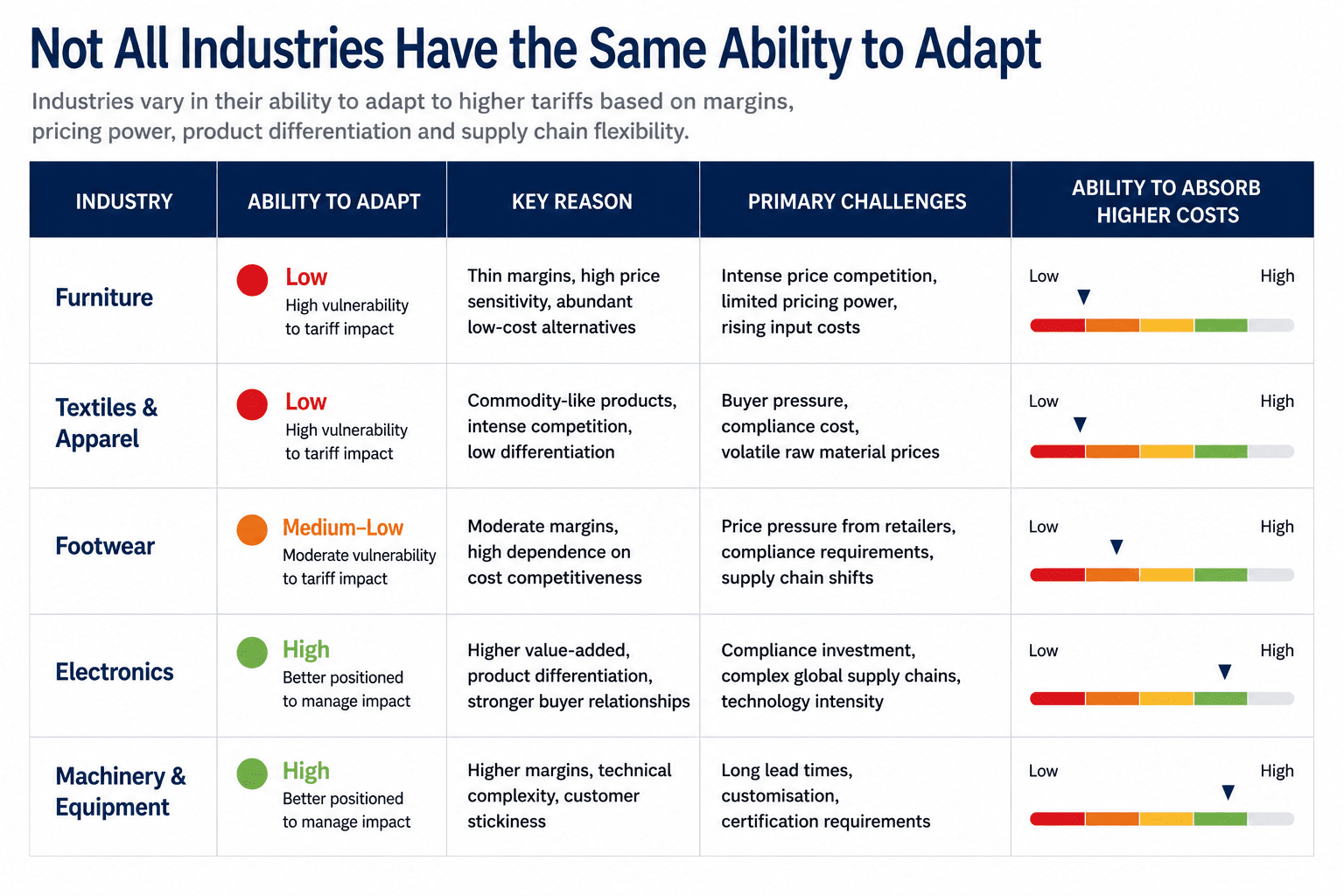 Beyond individual sectors, a clear pattern is emerging. Industries that are better positioned to adapt tend to share several characteristics: higher product differentiation, stronger bargaining power, greater supply chain flexibility and deeper integration with domestic or diversified supplier networks. Conversely, labour-intensive industries that compete primarily on cost remain more exposed to pricing pressure and stricter origin-verification requirements. These structural differences increasingly shape competitiveness as much as tariff levels themselves.
In general, businesses facing the greatest pressure tend to share three characteristics: they compete primarily on price, rely heavily on imported intermediate inputs and have limited pricing power with customers. By contrast, companies with higher levels of local sourcing, more differentiated products and greater supply chain flexibility are generally better positioned to adapt.
5. Which Investments Should Businesses Prioritize?
In the short term, businesses can respond to higher tariffs by renegotiating prices and reducing operating costs. Over the longer term, however, the investments that create the greatest value are those that strengthen supply chain control and resilience.
Priority areas include:
- Standardising documentation for Rules of Origin and raw material sourcing.
- Establishing batch-level traceability systems.
- Assessing supplier risks, particularly for imported intermediate inputs.
- Increasing local content where domestic production is commercially viable.
- Digitalising production, warehousing and logistics data.
- Implementing internal compliance procedures covering labour standards, intellectual property and trade regulations.
These investments are not only relevant to the US market. Requirements for traceability, labour standards and supply chain transparency are also becoming increasingly common across the European Union, Japan and many other developed markets. As a result, businesses are likely to benefit from these capabilities even if tariff policies evolve in the future.
6. From Tariff Pressure to a New Basis for Competition
The latest tariff adjustments are unlikely to affect all businesses in the same way. Companies operating with thin profit margins, relying heavily on imported intermediate inputs and competing primarily on price are expected to face the greatest pressure. By contrast, businesses with stronger control over their supply chains, more differentiated products and consistent delivery performance are generally better positioned to retain customers and remain competitive.
For Vietnamese exporters, the key question is no longer simply how high the tariff rate is. Increasingly, competitiveness depends on how effectively businesses can demonstrate product origin, manage raw material sourcing and respond to customer requirements. At the same time, reducing logistics costs, shortening delivery lead times and minimizing supply chain disruptions will become increasingly important in maintaining competitiveness in the US market.